
Particle Engineering by Agglomeration Processes
Particle engineering is all about the combined action of a base material, processing equipment and catalysts. The challenge is to form particles from this combination, which have the precise properties that contribute toward the successful application of the product by the end user. An important tool in this respect is the agglomeration process.
The role of a mechanical engineer such as Hosokawa Micron in Doetinchem involves much more than simply delivering machines and installations. The client is faced with the task of creating powders or grains that are suitable for the end user's objective. In the majority of cases, that product, whether in the form of powders or grains, must satisfy a series of requirements. The end user will need, for example, to dose, mix and dissolve the product. In that instance, the grains must flow freely, have a specific strength and particle size and must have an excellent wettability. It is absolutely essential that a client discusses the desired properties and functionalities of the product with the machine designer.
Particle Engineering
The knowledge and experience of Hosokawa Micron enable the company to engineer the grains in such a way that they possess the desired physical properties. Sometimes, the compatibility of these properties is poor and it is necessary to seek an optimum balance. This may lead to a situation whereby, for example, a client is suggested to opt for an agglomeration, instead of for a pellet. In other instances, it is suggested that properties relating for example to the drying behaviour, porosity, specific particle surface, bulk density or compressibility be achieved with layered particles. Only when the most important functions of the end product have been formulated is it possible to examine the various processes that can be applied in order to form the desired particles and achieve the desired properties. This brings us to the stage in which a process is translated into machines and installations, which is yet another process that takes place in close consultation with the client.
Agglomeration
In many instances, the base materials used to form the product are poor-flowing powders. These poor flow properties are often a result of Van der Waals forces, electrostatic charges and coarse particle surfaces. An essential process, used specifically to improve the flow properties of such powders, is agglomeration. This process involves the interaction of the base material with the processing equipment and catalysts. The process often begins with a mixing phase, during which a liquid is fed into the base material. Liquid bridges then form between the product particles, as a result of which agglomerations form. The strength of the agglomerations can be improved by means of adding a binder. The liquid bridges in the agglomeration can be converted into solid bridges by drying. These solid bridges consist of the product itself, or of crystallised binder.

Oil-Based Binders
The choice of binder is extremely dependent on the application of the end product. Some binders are edible, whilst others are not. The strength of the binder varies somewhat. In the case of some binders, it is possible to easily crush or smear the agglomeration between the thumb and forefinger, whilst other binders on the contrary produce an extremely strong agglomeration. In the case of oil-based binders, the melting process is highly important, in relation to both food and non-food products. It may for instance be a requirement that the granules disintegrate at a temperature of 80°C, because the product is extruded at this temperature. Examples of oil-based binders include palm oil, cocoa butter, polyethylene glycol (PEG) and paraffin.
Water-Soluble Binders
In addition to oil-based binders, water-soluble binders are also applied. Examples of edible, water-soluble binders include molasses, CMC (CarboxyMethyl Cellulose) and modified starch. Molasses give rise to a strong, stable agglomeration. Agglomerations based on CMC and modified starch are weaker than this. Starch can be added to the base material both in powder form and as a solution. A non-edible, water-soluble binder is sodium silicate. This binder is applied within the chemical and minerals industry. It produces solid granules that dissolve relatively slowly in water. Somewhat more costly water-soluble binders include PVP and PVAc (polyvinyl pyrrolidone and polyvinyl acetate), which are used for the formation of strong agglomerations.
Principles of Agglomeration
Different principles can be applied to form agglomerates, each associated with specific equipment:
- Compaction: An agglomeration technique based on the application of pressure is the Kompaktor. In this roller press, particles are compressed together under high pressure. A related technique is extrusion, where the resulting product (the compactate or extrudate) has a defined shape and dense structure.
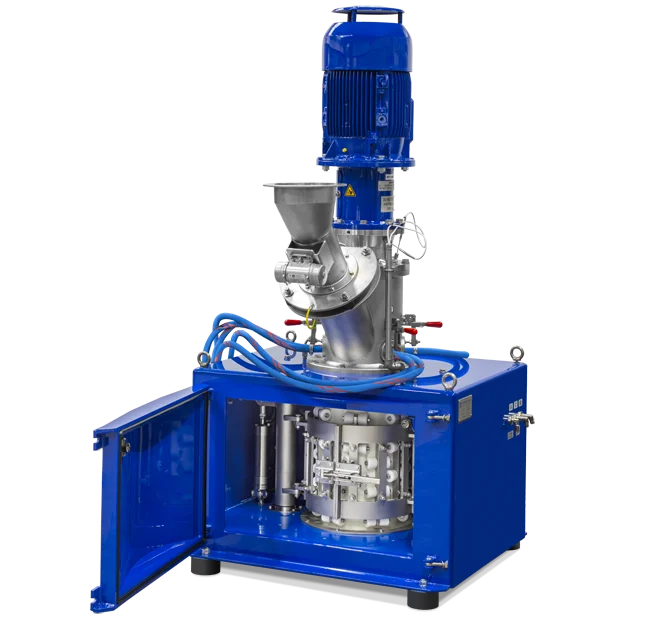
- Impact Agglomeration: A method to enlarge particles by making them collide intensively. The Flexomix utilizes this impact principle. In a vertical, high-speed product stream (20-50 m/s), an agglomeration liquid is sprayed and immediately dispersed into the product. This results in porous agglomerates with a raspberry-like structure.
- Shear Agglomeration: In shear agglomeration, particles are rubbed against each other, generating high shear forces. The Cyclomix is a device that operates based on this principle. The resulting agglomerates are generally dense and stable.
Drying and Cooling
The final stage of the agglomeration process may incorporate a drying stage (for water-soluble binders) or a cooling stage (for oil-based binders). The time at which drying or cooling takes place, the rate of drying or cooling and the drying or cooling intensity all bear a strong influence on the quality of the agglomeration and must therefore be determined with a view to the final application of the product.
Talk to Our Experts
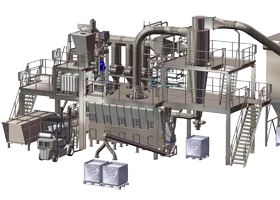
Let our process specialists help you develop the optimal solution for your powder and bulk solids processing – from the first trial in our test centre to a full-scale industrial production system.

Sustainable Process Technologies
Hosokawa Micron B.V. is committed to sustainable and responsible process technology. Our ISO 14001 certification covers key environmental aspects such as air, soil, energy, waste, water, noise and hazardous substances. With an EcoVadis Silver Medal, we rank among the top 15% of EcoVadis-rated companies in the special machinery industry.