

Safely Drying and Cementation of Ion-Exchange Resins
The nuclear industry relies heavily on water, which often becomes contaminated during various processes. To remove this contamination, ion-exchange resins are commonly used. These resins, once polluted, must be safely handled and stored due to their radioactive content. Hosokawa Micron has developed two methods to prepare contaminated ion-exchange resins for long-term waste storage: drying prior to cementation and direct cementation.
Drying of Resins Prior to Cementation
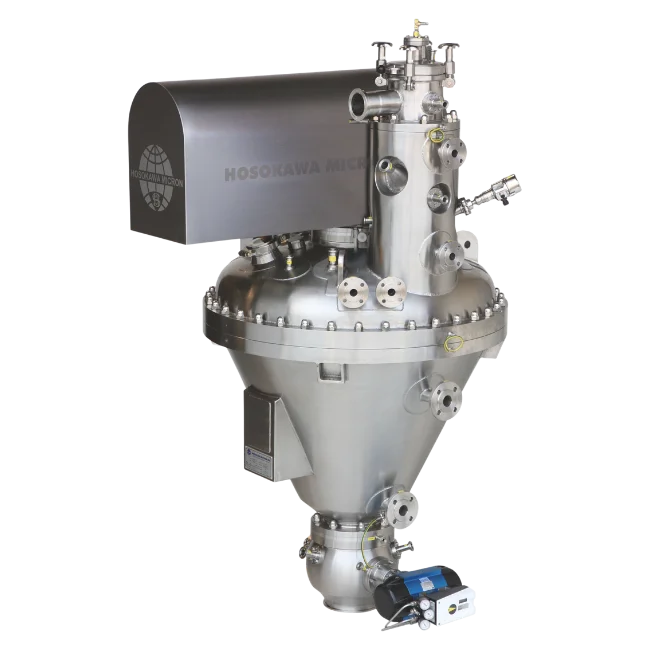
The waste water and resin mixture is first collected before being dried to reduce its volume. This mixture is then fed into a specially modified Nauta® vacuum dryer. Special filter elements, integrated into the vessel wall near the base of the dryer, enable efficient water removal, concentrating the polluted resin. Once the fill level is reached, vacuum and heat are applied, reducing the moisture content from 50-55% (wt) down to around 4%. The final product temperature reaches approximately 100°C.
The hot, dried resin is discharged into special drums, which are immediately pressed to reduce their volume to less than 30% of their original size. Four to five of these compressed drums are then placed into a larger drum, which is filled with cement and sealed for long-term storage.
Cementation of Wet Resins
In an alternative process, the water-resin mixture is collected and initially dried using a filter press. The dried material is then mixed with cement in a drum-type mixer. After mixing, the drum is sealed, and the contaminated mixing rotor is disposed of in the final drum of each cleaning campaign.
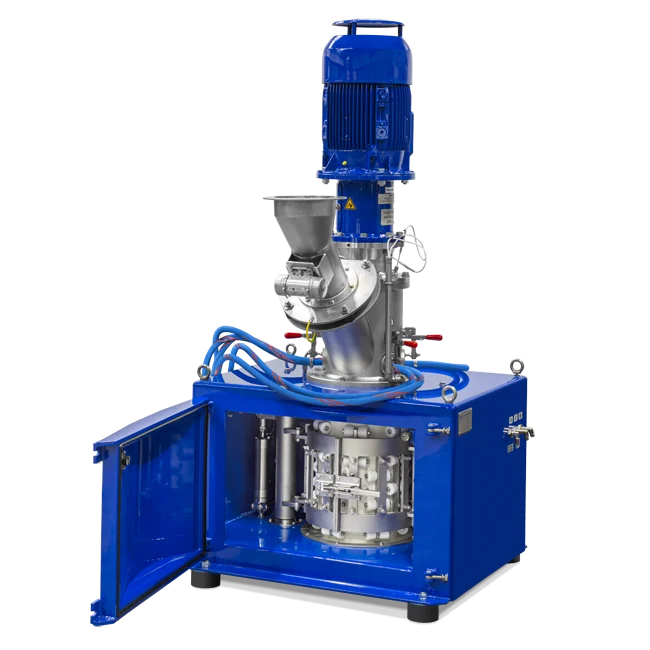
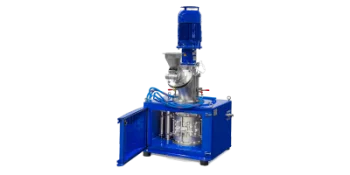
However, the need to discard the rotor after every campaign adds significant operational costs. To resolve this, Hosokawa Micron collaborated with customers to develop a more efficient method that preserves the rotor. This led to the development of a modified Flexomix high-impact mixer, which features two inlets—one for the pressed resin and one for cement. Water is added during the mixing process, and the collection drums are pressed to the bottom of the Flexomix unit. The drum fill level is monitored via radar detection and a camera mounted inside the Flexomix housing.
The Flexomix, with its stainless steel mixing chamber and integrated vibrator, ensures thorough mixing and prevents product buildup.
Benefits of Both Methods
The method using the vacuum dryer significantly reduces the number of contained drums per campaign. The method using a Flexomix has the big advantage that rotor disposal is eliminated.
Testing & Process Development
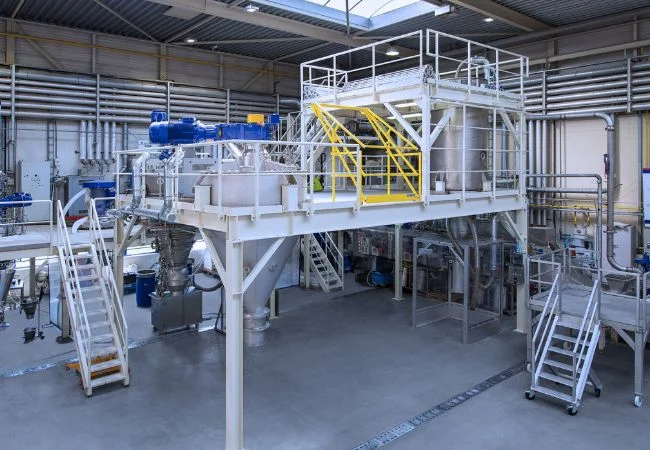
Our Test and Process Development Centre in the Netherlands offers unique possibilities for testing your product to determine the most efficient process, system or plant prior to final design. We can provide laboratory-level as well as production-sized trials.
Whether you wish to test a single machine or a complete powder processing system, the same skilled and experienced staff are here to help ensure that your requirements are met, and that you are entirely satisfied with the results.
We offer process equipment and technologies from individual units to large scale bespoke system solutions. Our principle is to deliver high performance yet affordable solutions that meet our customers' demands and long term challenges.
Talk to Our Experts
Let our process specialists help you develop the optimal solution for your powder and bulk solids processing – from the first trial in our test centre to a full-scale industrial production system.

Related Process Equipment
Sustainable Process Technologies
Hosokawa Micron B.V. is committed to sustainable and responsible process technology. Our ISO 14001 certification covers key environmental aspects such as air, soil, energy, waste, water, noise and hazardous substances. With an EcoVadis Silver Medal, we rank among the top 15% of EcoVadis-rated companies in the special machinery industry.